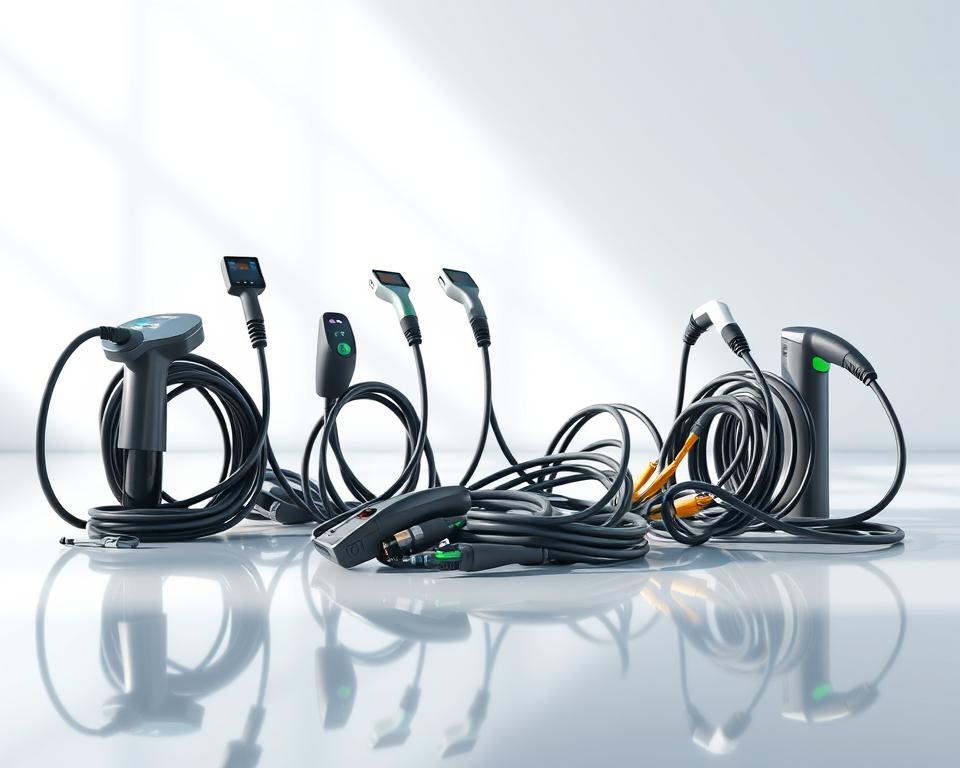
The EV market is expanding rapidly, with the demand for reliable and high-performance charging solutions growing exponentially. Today, top brands have been at the vanguard of this change, providing high-quality charging infrastructure. Southwire, for instance, entered the market in 2014 and excels, garnering 1000+ five-star reviews and 75 years of experience in the electrical construction industry.
The surge in electric vehicle adoption necessitates the need for durable, fast, and reliable EV Charger Manufacturers. Leading brands are innovating to address changing requirements, offering products that improve the overall charging experience.
Grasping the distinctions between various charging solutions is essential for choosing correctly. Quality charging infrastructure has a direct effect on vehicle performance and user experience.
Significant Points
Key suppliers deliver top-tier cables enhancing lifespan and protection.
EV market expansion drives need for high-efficiency chargers.
Top brands pioneer solutions for changing EV requirements.
Quality charging cables directly impact charging efficiency and vehicle performance.
Investing in quality charging infrastructure is beneficial in the long run.
The Critical Role of Premium EV Charging Cables
As electric vehicles become increasingly popular, the value of top-grade EV charging cables is immense. The performance, safety, and reliability of electric vehicle charging systems hinge upon the quality of the charging cables used.
Advancements in EV Charging
Electric vehicle charging technology has undergone significant advancements in recent years, with a focus on speedy charge times and improved safety features. Modern EV charging cables are designed to meet these evolving needs, incorporating high-grade materials and advanced designs to minimize power loss and maximize transfer rates.
Quality’s Impact on EV Charging
High-grade cables ensure reliable, safe charging. Durable features, such as weather resistance and flexibility in extreme temperatures, ensure reliable operation across various environments. Additionally, meeting standards and adherence to industry guidelines are essential in guaranteeing safe operation.
Key Features
Benefits
Superior materials and construction
Minimized power loss during energy transfer
Robust durability
Weather resistance, flexibility in extreme temperatures
Standards adherence
Certified safety
Serviceability
Repairable design for longevity
Our high-performance cable solutions, such as those offered by Aichie Tech Electronics, are tested for quality and compliance in The Cable Lab. Choosing maintainable Portable EV Charger Manufacturer, repairable designs reduce lifetime costs, lowering environmental impact.
China’s Leading EV Cable Makers
China is home to a growing number of EV charging cable manufacturers. These companies are crucial in supporting the expanding electric vehicle (EV) market, providing high-quality automotive cables designed for various charging needs.
Wottz: Industry Leaders Since 2014
Wottz has been a leading cable manufacturer since 2014. They offer a range of cables that meet the specific requirements of EV charging systems, from Mode 1, 2, 3, and DC Fast Charging (Mode 4).
Aichie Tech Electronics – 75 Years in Electrical Solutions
Aichie Tech Electronics’ seven-decade legacy informs its premium cable designs. Their products are designed to meet the demands of both domestic and commercial EV charging infrastructure.
Additional Key Cable Suppliers
Specialists in Type 1/Type 2 connectors and environmental-resistant cables are emerging players. These include specialists in Type 1 (J1772) and Type 2 (Mennekes) connectors, as well as companies developing cables with enhanced flexibility and resistance to environmental factors.
A Guide to EV Cable Types
As electric vehicles become increasingly popular, understanding the various types of EV Charging Cable Manufacturers is crucial for optimal charging experiences. Knowing cable types ensures you pick the right charger. The variety in EV charging infrastructure necessitates a closer look at the different cable types available.
Type1 vs. Type2 Charging Cables
Type1 and Type2 charging cables are two common standards used for EV charging. Type 1, also known as SAE J1772, is North American standard, while Type 2, or Mennekes, is the European norm. The right cable matches your car and charger. Type 2 cables often support higher charging capacities, making them ideal for speed.
AC Level2 vs DC Fast Charging
Level2 charging cables offer faster charging than Level1, using 240V AC power to deliver up to 19.2 kW of power. DC Fast Charging cables, on the other hand, provide rapid charging by converting AC power to DC within the charging station, delivering rapid fill-ups. These cables are key for highway charging, enabling drivers to recharge quickly.
Portable and Tethered Cable Options
Granny chargers plug into home outlets for emergency use. Tethered cables are fixed to charging stations, providing a convenient but less flexible charging solution. The choice comes down to flexibility vs convenience.
Cable length, power rating, and connector type matter most. For instance, portable charging cables range from simple L1 cords to full L2 kits. Vehicle-to-load (V2L) cables let EVs act as mobile power banks.
Portable charging cables offer flexibility, with options ranging from basic to more robust Level2 solutions.
Tethered cables are permanently attached to charging stations, limiting flexibility but eliminating the need for personal cables.
Cable length is a critical consideration, with options ranging from 5-meter standard cables to 50-meter extended cables.
Key Features of High-Quality EV Charging Cables
High-quality EV charging cables are distinguished by several key features that ensure reliable and safe charging. These features are vital to safe, efficient charging.
Robustness and Weatherproofing
Durability and weather resistance are paramount in EV charging cables. Manufacturers like Wottz and Southwire use RoHS-compliant recyclable compounds, ensuring they perform in harsh climates. Their repairable builds support longevity and eco-reuse.
Flexibility and Ease of Use
Cables need to flex yet remain tough. High-quality EV charging cables are designed to be flexible, making them easier to handle and maneuver. This flexibility does not compromise their durability, as they are built to withstand regular use.
Safety Certifications and Compliance Standards
Approved safety marks ensure reliable performance. They ensure their products meet or exceed standards such as IEC62196 for connectors and UL2594 in North America. Independent labs verify safety, toughness, and weatherproofing.
Certification
Description
Region
IEC62196
Connector safety standards
International
UL2594
Standard for electric vehicle supply equipment
North America
ROHS
Restriction of hazardous substances
International
By focusing on these key features, manufacturers can provide EV charging cables that not only meet the highest quality and safety standards but also enhance the overall user experience.
Innovative Technologies from Leading EV Charging Cable Manufacturers
New cable tech is transforming EV charging, with a focus on ultra-fast charging, reliable data transfer, and eco-friendly materials.
Hyperboloid contact points improve electrical connection, ensuring stable communication and power flow.
Eco-Friendly Cable Compounds
Leading manufacturers are prioritizing sustainability in their cable designs, using recyclable materials and eco-friendly compounds that reduce environmental impact. For instance, companies like Aichie Tech Electronics and Wottz are adopting serviceable design philosophies and RoHS compliance to minimize waste and promote recycling.
Programs for cable recycling, non-toxic compounds, and TPU sheaths mark the eco shift.
Buyer’s Guide to EV Charging Cables
Selecting the proper cable ensures optimal performance. To make an informed decision, consider several key factors.
Compatibility with Your Electric Vehicle Model
Ensure the charging cable is compatible with your vehicle’s connector type. Your vehicle’s onboard charger capacity sets the upper limit for AC power.
Picking the Right Cable Length
Select a cord length based on parking and outlet location. A longer cable adds reach at the cost of extra weight.
Matching Power and Speed
Match your cable’s power handling to your vehicle’s capabilities. Standard Level 2 home charging operates at 7.2 kW, but some vehicles support up to 19.2 kW with appropriate electrical service.
Mind these points to pick a cable that fits your EV lifestyle.
Why Choose Premium Charging Solutions
With EV growth unabated, premium cables are essential. Choosing cables from Wottz or Aichie Tech Electronics provides long-term value and reliability. Their serviceable designs allow for component replacement, reducing waste and costs. This approach aligns with the core values of electric vehicle ownership by promoting sustainability.
Premium cables offer certification, future proofing, and reliability.
The Next Era of Information Transmission: Fiber Optic Networking Innovations
Did you know that one hair-thin fiber can transmit more than 100 Tbps of information each second? That’s enough to stream 12 million HD movies simultaneously—quite a jump compared to the 1950s, when researchers began using light for rudimentary signaling.
Data speeds a hundredfold greater than legacy copper cables
Zero interference from power lines or radio signals
Ability to handle 5G infrastructure and 8K video
Characteristic
Copper Wiring
Optical Fibers
Speed
Up to 10 Gbps
100+ Tbps
Distance
Approximately 100 m
Over 70 km
Privacy
Easily tapped
Highly resistant to eavesdropping
Light pulses bounce through glass cores using total internal reflection, similar to a laser light bouncing in a mirrored corridor. This optical principle avoids data loss across vast spans. As video calls and smart devices multiply, these cables keep networks from collapsing under data weight – FTTH cable production line.
The Development Path of Fiber Optic Communications
Years of research turned the concept of optical data transmission into a working technology. Researchers in the 1950s discovered that glass strands could guide light—a concept that reshaped modern connectivity.
Early Experiments and Pioneers
In 1952, Narinder Singh Kapany demonstrated that light could propagate through curved glass fibers. His work coined the term “fiber optics” and laid the foundation for today’s networks. Together with Harold Hopkins, he created pliable imaging bundles, which became prototypes for data-carrying fibers.
By the 1960s, labs demonstrated practical uses for these strands. Although initial implementations suffered loss, ongoing experiments improved their efficiency. Engineers realized purified glass cores could carry light pulses farther without distortion.
Milestones in Fiber Development
The 1970s marked a turning point with the first commercial installations. Telephone companies adopted cables that replaced copper lines, boosting call clarity and capacity. Corning Glass Works achieved a critical breakthrough in 1970—low-loss optical fiber that could transmit signals over 65 kilometers.
Year
Achievement
Impact
1977
Initial live telephone transmissions
Proved real-world reliability
1988
Launch of TAT-8 transatlantic link
Linked Europe and North America
1990s
Erbium-doped amplifiers
Enabled long-distance networks
Today’s innovations prioritize higher throughput and expandability. Dense wavelength-division multiplexing (DWDM) now lets single strands carry multiple data streams simultaneously. Such progress connects laboratory research to worldwide network infrastructures.
Fundamentals of Fiber Optic Communication Technology
Given light’s unmatched speed, it’s a perfect medium for data transmission. This simple idea powers modern networks. Instead of slow electrons in copper wires, engineers use photons to zip data across continents. Below is the fundamental mechanism.
Photons vs. Electrons: Why Light Wins
Light pulses carry information more efficiently than electricity. Photons:
Travel at ~186,000 mi/s (~99.7% of c)
Generate no heat or EMI
Can carry multiple signals at once using different wavelengths
Criterion
Electron Signaling (Copper)
Photon Signaling (Fiber)
Speed
Up to 10 Gbps
100+ Tbps
Interference
Vulnerable to electrical noise
Unaffected by EMI
Power Consumption
High
Low
Total Internal Reflection in Fiber Cores
Light stays trapped in the core—the central glass strand—thanks to total internal reflection. The core has a higher refractive index than the surrounding cladding. When light hits the boundary at a steep angle, it bounces back like a mirror, staying on course for miles.
Such a design minimizes attenuation. Over extensive spans, nearly 95% of photons arrive intact. Paired with precise lasers, it guarantees clear video conferencing and rapid downloads.
Various Fiber Cable Categories
Not all glass strands are created equal. The right cable type depends on how far your data needs to travel and how much information you’re sending. Let’s break down the two main categories and their specialized designs.
Attribute
Single-Mode
Multi-Mode
Core Size
~9 microns
~50–62.5 microns
Throughput
100+ GHz
~35–500 MHz
Maximum Span
120 miles
~1,600 ft
Typical Applications
Telecom networks
Data centers
Medical centers deploy single-mode links to move MRI scans across campuses. Schools often pick multi-mode for classroom networks—it handles video streams without breaking budgets. Both types keep our world connected, just in different ways.
Fiber Optic Cable Construction and Key Components
Curious how connectivity persists despite storms? This is due to advanced cable engineering. These high-tech threads use multiple layers to protect data while traveling at light speed.
Core, Cladding & Coating Explained
Each fiber’s core is ultra-thin, even narrower than human hair. This ultra-pure strand carries light signals using total internal reflection. Surrounding it, the cladding layer acts like a mirror, bouncing stray photons back into the core.
A protective acrylate coating wraps these layers. This ~250 µm barrier safeguards against physical abrasions and water ingress. Together, these components form the light-carrying highway inside every optical fiber.
Armoring and Outer Protection
Kevlar® reinforces the coated core, ensuring tensile strength. Aramid strands handle pulling forces to avoid fiber breakage. An outer polyethylene jacket completes the package, resisting weather, chemicals, and curious rodents.
Layer
Material
Purpose
Central Glass
Pure silica glass
Light transmission
Cladding
Doped silica
Signal containment
Coating
Acrylate polymer
Physical protection
Outer Sheath
Polyethylene
Environmental shield
Color coding matters too—orange jackets denote multi-mode cables, while yellow marks single-mode versions. Technicians rely on these hues to differentiate fibers for setup or troubleshooting.
Working Principles Behind Data Transmission
What enables near-light-speed data transfer with minimal loss? It involves converting electrical pulses into controlled optical bursts. Each pulse represents binary code—flashes for 1s, gaps for 0s—creating a rapid-fire Morse code only lasers can read.
Photon-Based Signaling
Lasers emit ~500 million pulses/sec through fiber cores. Advanced FTTH cable production line techniques like QAM-16 pack 4 bits into each flash, quadrupling capacity. This photon dance happens with near-zero electromagnetic interference, unlike older copper-based systems.
Managing Dispersion & Attenuation
Two primary issues compromise signal integrity:
Wavelength dispersion: Various wavelengths travel at dissimilar velocities.
Mode dispersion: Multiple ray paths diverge in multi-mode fibers.
Modern cables combat these issues through:
Remedy
Outcome
Gain
Doped glass cores
Equalizes wavelength speeds
~40% reduction in pulse broadening
Digital signal processors
On-the-fly error mitigation
>99.999% fidelity
Signal loss drops to 0.15 dB/km in premium cables—a 92% reduction from early designs. Paired with EMI-resistant layers, they preserve signal fidelity worldwide. Consequently, transoceanic calls remain sharp despite severe weather.
Sophisticated Fiber Networking Techniques
What keeps your video calls from freezing during a storm It involves connectors and installation practices that underpin contemporary communications. These components ensure seamless data flow across cities and continents.
Fiber Termination & Splicing Methods
Network reliability starts with proper connections. SC connectors snap into place with push-pull ease, while LC types save space in crowded server racks. MPO/MTP designs handle multiple strands at once—perfect for data centers moving massive files.
Mechanical jointing: Uses alignment sleeves for fast, reusable splices.
Connector
Best For
Insertion Loss
SC
Commercial infrastructures
0.25 dB
LC
Dense patch panels
0.20 dB
MPO
Cloud applications
0.35 dB
Contemporary Network Architectures
Modern designs require adaptable deployment methods. Micro-ducts let technicians blow cables through underground pipes, while armored designs withstand harsh outdoor conditions. In smart cities, fibers weave through traffic lights and security cameras, creating responsive urban networks.
Major telecom providers now deploy hybrid cables combining power lines and optical strands. Such designs feed 5G small cells and IoT sensors alike, showcasing agile network evolution.
High-Speed Data Transmission and Bandwidth Benefits
Imagine data as water in pipes: larger pipes yield greater flow. This bandwidth principle underlies the shift to fiber optics. While copper resembles a garden hose, fiber performs like a high-capacity firehose.
Light signals traveling at 186,000 miles per second
Many channels by WDM
Error correction reducing resend requests by 80%
Decade
Peak Throughput
Cost per GB
1980s
~45 Mbps
$1,200
2000s
~10 Gbps
$0.12
2020s
~178 Tbps
~\$0.0004
Throughput dictates online performance. Videoconferencing needs 5 Mbps per user, while VR demands 50 Mbps. As NEC’s 2023 report shows, networks using glass cables support 40x more users than copper alternatives at half the energy cost.
“Every dollar invested in high-capacity networks yields $3.80 in economic growth through improved productivity.”| “Each \$1 poured into high-bandwidth infrastructure returns \$3.80 in productivity gains.”
Enhanced performance trims OPEX. Signals travel 60 miles without repeaters versus copper’s 3,000-foot limit. This efficiency enables 8K video streaming, real-time AI processing, and seamless cloud backups—all while keeping your monthly bill under $100.
Overcoming Interference and Signal Loss in Fiber Systems
Ever tried making a call during a thunderstorm only to hear static Copper wiring falters when EMI spikes. Optical fibers shrug off such noise. By leveraging photons rather than electrons, they eliminate interference from electricity or RF sources.
Inherent EMI Immunity
While copper acts as an antenna, fiber is non-conductive. Hence, optical networks remain unaffected by external interference. A 2023 study found 92% fewer data errors in industrial settings when using light-based systems compared to older methods – Fiber draw tower.
Engineers combat signal loss through three key strategies:
Ultra-pure glass cores reduce light scattering
Accurate laser coupling decreases insertion loss
Hydrophobic layers block water infiltration
Factor
Copper
Fiber
Interference Risk
Significant
Negligible
Attenuation per Mile
3 dB
~0.2 dB/mi
Maintenance Needs
~Monthly upkeep
~Yearly reviews
“Our factory’s error rates dropped 80% after switching to light-based networks—no more machine downtime from radio interference.”| “After switching to fiber, error rates fell by 80%, eliminating downtime from RF noise.”
These cables thrive where others fail. Undersea lines resist seawater attack; desert runs survive sandstorms. With 99.995% uptime ratings, they’ve become the backbone of mission-critical systems worldwide.
Fiber’s Role in Telecom & Internet Services
How does your Netflix show arrive instantly from across the globe Fiber networks serve as the neural pathways of today’s Internet. These systems power everything from streaming services to stock market trades, using light to bridge continents.
Long-Distance & Metropolitan Fiber Deployment
Undersea fibers run ~750,000 mi, handling ~99% of intercontinental data. In cities, metro networks link cell towers and offices using hair-thin strands. Transmitters convert electrical signals to light pulses, while receivers decode them at destinations.
Feature
Copper Networks
Glass-Based Networks
Throughput
~1 Gbps
~100 Tbps
Latency
5 ms/km
~0.005 ms per km
Uptime
99.9%
~99.995%
Data Center & Cable Television Uses
Within data centers, fibers enable rack-to-rack transfers, shifting petabytes each day. Cable providers deliver 4K content through hybrid fiber-coaxial systems. Verizon’s 2023 upgrade cut buffering complaints by 73% in urban areas.
Economic incentives accelerate uptake:
60% lower maintenance costs than copper
Easily scalable for 5G traffic
Energy consumption ~40% less per data volume
From Manhattan’s financial district to Pacific submarine routes, these communication systems prove that speed and reliability can coexist. As one engineer noted: “You can’t beat light for moving mountains of data.”
Emerging Technologies in Fiber-Optic Applications
Imagine networks accommodating 8 billion simultaneous video streams. That’s the promise of next-gen innovations reshaping how we move information. Advanced transceivers and modulation schemes drive network evolution.
Next-Gen Transmitters & Detectors
Modern lasers now fire 200 wavelengths simultaneously—up from just 40 a decade ago. These tiny chips pack 5x more power while using 30% less energy. Paired with graphene-enhanced detectors, they spot faint light signals other devices miss.
Key breakthroughs include:
Lasers with narrow linewidths cut optical noise by ~90%
Machine-learning calibration optimizes performance in real time
Coherent Transmission and Multiplexing Techniques
Coherent optics modulate both phase and amplitude to encode information. This trick boosts capacity 16-fold compared to older on-off signaling. Coupled with WDM, fibers can transport over 800 channels.
Technique
Wavelengths
Speed Gain
DWDM
~160
~80 Tbps
OFDM
~512
120 Tbps
SDM
Multi-core fibers
~1 Pbps*
*Under development by NTT, 2023 results
Such approaches mesh with current networks with minimal overhaul. In 2024, Verizon’s coherent deployment doubled bandwidth on existing fiber routes. An engineer remarked: “Repurposing legacy fibers with coherent methods unlocks untapped potential.”
Worldwide Fiber Standards & Guidelines
Ever wondered how your video call stays crystal clear across continents Universal protocols guarantee seamless interoperability across diverse systems. Absent these specs, infrastructure would face mismatches and inefficiencies.
Specification
Focus Area
Impact
ITU G.652
Single-mode transmission
Supports >100 Gbps links
IEC 60793-2-50
Mechanical reliability
Certifies two-decade service life
ITU G.654
Undersea fiber
Enhances marine durability
Performance Metrics and Quality Assurance
Consistent testing keeps networks running smoothly. Key benchmarks include signal loss (under 0.25 dB/km) and tensile strength (minimum 50 Newtons). Vendors conduct over 200 quality tests, including thermal and bend stress trials.
“Our compliance with IEC 61300-3-35 reduced installation errors by 65% last year.”| “Adhering to IEC 61300-3-35 led to a 65% drop in deployment mistakes.”
Verified components and accurate technical data prevent costly mistakes. Technicians rely on uniform color schemes and termination practices to link heterogenous gear flawlessly. Such uniformity preserves uninterrupted global data exchange.
Case Studies: Successful Fiber Optic Implementations
How can metropolises support massive concurrent streaming demands? Real-world deployments show how smart planning and advanced cables keep our digital world running smoothly. Let’s explore two groundbreaking projects that reshaped global connectivity.
Urban Deployments and Metro Networks
New York City’s Metro Fiber project tackled a major challenge: aging copper lines causing 40% slower speeds in business districts. Engineers installed 800 miles of micro-trenched cables under sidewalks, avoiding subway tunnels and gas lines. Outcomes: Latency fell from ~14 ms to ~2 ms; throughput increased by ~600%.
Issue
Approach
Outcome
Subsoil crowding
3D mapping for route optimization
92% faster installation
Signal interference
Armored MC fiber
99.99% uptime
Budget constraints
Public-private partnerships
30% cost reduction
Underwater & Cross-Ocean Deployment
MAREA spans ~4,000 mi from Virginia to Spain, delivering ~160 Tbps over 8 pairs. Installation crews faced 10,000-foot depths and shark bites, using robotic subs to bury strands in seabed sediment. Costing \$160M, it transmits ~55% of transatlantic data.
“Subsea systems require 200+ design revisions before deployment. Every meter matters when you’re laying cable across tectonic plates.”| “Over 200 design iterations are typical for undersea cables. Small changes hugely impact viability across plates.”
Differences by deployment scenario:
Urban projects use bend-resistant cables for tight corners
Subsea systems require titanium-reinforced sheathing
Either method shows how sound engineering and robust materials revolutionize data transport. Spanning city high-rises to sea depths, fiber underpins today’s digital existence.
Fiber Economics & Growth Potential
What powers the streaming revolution and remote work boom The answer lies in networks that combine upfront investment with long-term savings. Though \$60K/mi can be spent on installation, these fibers pay off over years of use.
Strategic Investment for Scalability
Upgrading to advanced networks cuts operational costs by 40% compared to copper systems. Fewer repairs are needed—no more corrosion issues or EMI troubleshooting. A 2024 study showed:
Expense Category
Legacy Systems
Fiber-Based
Deployment
~\$45/m
\$28/meter
Energy Use
5W per device
1.2W per device
Service Calls
12/year
~2 annually
Worldwide spending reflects this transition. Major carriers will invest ~\$150B by 2027 to grow fiber footprints. Locale upgrades hit ~300% ROI in 5 years via boosted efficiency and minimized outages.
Overcoming Rollout Challenges
Despite clear benefits, cities face three key challenges:
Permitting delays adding 18 months to timelines
Labor shortages in specialized installation crews
Community pushback against trenching
“Our Phoenix deployment took 22 months instead of 14 due to permit bottlenecks. Still, the network boosted local GDP by \$380 million annually.”| “Phoenix’s build required ~22 months, not 14, over permit delays—but delivered ~\$380M/year in GDP uplift.”
Innovative solutions are emerging. Micro-trenching reduces street disruption by 80%, while public-private partnerships share financial risks. Such strategies enable cost-effective, scalable fiber deployment.
Innovations and Future Prospects in Data Transmission
Fiber backbones are receiving performance upgrades. Scientists explore sub-micron fibers and advanced modulations beyond existing standards. Such progress aims to reduce latency and accommodate future data surges.
Upcoming Fiber Innovations
MIT’s 2024 experiments suggest hollow-core fibers (air-filled) may cut latency ~30%. These tubes guide light through vacuum-like channels, reducing signal drag. Simultaneously, multi-core designs pack seven data lanes into one cable—quadrupling current capacity.
Metric
Current Tech
2027 Projection
Speed
100 Tbps
1.2 Pbps
Reach
70 km
150 km
Energy Use
0.5 W/device
~0.15 W/device
Emerging WDM packs ~400 channels per fiber, versus ~160 currently. This spectral densification enables 8K VR without congestion.
Convergence with 5G/6G Networks
6G networks will lean heavily on upgraded cables to support millimeter-wave frequencies. Dallas field tests achieved ~10 Gbps wireless throughput over robust fiber backhaul.
Small cell sites in 5G require fiber connections ~500 ft apart
Smart factories use real-time data flows for robotic precision
Nokia’s 2023 report says advanced fiber cuts 5G round-trip delay by ~82%. In one expert’s words: “Wireless depends on wired guts—the quicker the spine, the clearer the signals.”
As a Final Point
The invisible threads connecting our digital world keep getting stronger. Over decades, advancements in materials and engineering transformed how we exchange information—from copper’s limitations to light-speed possibilities. Today’s networks prove faster isn’t just better—it’s essential for streaming, surgeries, and stock markets alike.
Modern systems thrive through smart design. Polymer coatings defend fragile cores; international specs guarantee interoperability. These innovations slash energy use by 40% compared to older methods, making high-speed access both sustainable and scalable.
Challenges remain, like installation costs and public awareness. Yet economic benefits outweigh hurdles—every $1 invested yields nearly $4 in growth. With 5G proliferation and AI requiring instant data, robust fiber backbones are imperative.
Looking ahead, researchers aim to push boundaries further. Hollow cores and advanced wavelength methods may render current rates outdated. One thing’s clear: the way we share knowledge will keep evolving, driven by humanity’s endless quest to connect faster, farther, and smarter.
Houston CNC Lathe Fabrication Experts – Tailor-Made Parts
What is required to fabricate accurate parts with speed and dependability? Distinctive Manufacturing Group shines as a premier source of state-of-the-art fabrication solutions in the region. Catering to locations including Central Houston, Sugar Land, and Pearland, they focus on premium tailor-made elements.
Featuring expertise in 5-axis operations and additive manufacturing, they manage intricate tasks with efficiency. Expertise in metals including titanium and high-grade steel ensures durability for industrial applications. Their ISO-certified processes and same-day quotes render them a proven partner for manual machining services Houston businesses.
Critical Summaries
Premier supplier for tailor-made processing in the local Houston market
Services include multiaxis fabrication and quick-turn prototyping
Works with robust materials like titanium and superalloys
Provides quick processing with instant quotations
Quality-assured for quality assurance
Accurate Turning Machining Solutions in H-Town
From pneumatic systems to aerospace components, customized equipment deliver accuracy. Notable Manufacturing Group delivers tailored solutions for sectors demanding centrically machined elements with narrow tolerance ranges.
Their CNC turning services include operations including face turning, thread cutting, and grooving. Boasting a 31-inch diameter and 30-foot length capability, they process substantial manufacturing tasks with ease.
Substances such as brass, alloyed copper, and hard steel are fabricated on a daily basis. For space-related projects, Inconel 718 is machined with expertise, ensuring durability under extreme conditions.
Metal
Frequent Uses
Accuracy (±)
Copper Alloy
Waterworks and circuits
0.005 inch
Inconel 718
Aircraft and turbine components
0.001″
Cutting Steel
Molds, cutting tools
0.003″
Secondary operations like thread measuring and API threading refine parts further. Each part is verified by Coordinate Measuring Machines for ±0.001″ accuracy.
Customers depend on these fabrication solutions for promptness and trustworthiness. Whether prototyping or full-scale production, precision is never compromised.
Why Opt for Our Houston CNC Lathe Solutions?
When precision and speed matter, selecting the right partner makes all the difference. Our customers rely on us for custom services that adhere to stringent timelines and maintain top-quality standards.
State-of-the-Art Tools and Machinery
Advanced technology deliver precision for intricate assignments. Featuring nearly continuous production, rush projects are finished promptly.
Experienced Machinists
Expert technicians handle substances such as Inconel and titanium. Their proficiency ensures steady performance, even for parts requiring narrow tolerances.
Quick Delivery
Expedited lead times and a same-day quoting system streamline workflows. A live tracking system keeps clients updated throughout production.
Around-the-clock operations for time-sensitive projects
Just-In-Time logistics cuts excess inventory
Dedicated logistics for Texas-wide deliveries
Productivity powers each assignment, guaranteeing dependable outcomes from initial design to mass manufacture.
What Our CNC Machining Can Do
Modern manufacturing demands adaptive strategies for challenging tasks. Whether designing detailed shapes or managing large production batches, advanced techniques guarantee exact accuracy and productivity.
Turning Operations
Rotational parts require exacting standards. Facing, threading, and grooving are executed with tolerances as tight as ±0.001″. Materials including brass and Inconel are fabricated for long-lasting performance.
Surface Machining
Milling systems fabricate both planar and curved finishes. Intricate recesses and mold designs are enhanced by milling.
“Precision isn’t just measurement—it’s repeatability under manufacturing demands.”
Advanced 5-Axis Machining
Simultaneous cutting reduces setup time for aerospace components. It enables machining of intricate angles and curves not possible with standard lathes.
Prototyping and Printing
Expedited prototype development validates design concepts rapidly. Stereolithography builds precise medical models, and FDM aids in functional trialing. DMLS delivers strong metal 3D printing options for functional parts.
Urethane molds for limited production
GD&T-compliant inspections
DFM feedback via CMM reports
Market Sectors We Cater To
High-performance sectors require precision-engineered parts for reliability. Distinctive Manufacturing Group delivers tailored solutions for industries where strength and exactness are required.
Aviation
Key aviation components must meet stringent specifications and use advanced materials. Ranging from engine parts to landing structures, pieces are built to resist high stress and temperature variations.
Oil and Gas
Durable valves, drill bits, and pipelines endure harsh environments. Large-scale fabrication supports continuous energy production with minimal interruptions.
Industry
Essential Elements
Material Examples
Aviation
Power assemblies and hydraulic units
Inconel, titanium
Petroleum
Valve bodies, drill collars
Stainless steel, duplex alloys
Defense
Ballistic shields and radar assemblies
High-strength alloys and composite structures
“In defense work, rapid efficiency is paramount—it’s mission-critical.”
Security Applications
Mission-ready parts are built for resilience. Custom jigs and armor components meet stringent military specifications with rapid turnaround.
Biocompatible Fabrication
Medical instruments and implant parts rely on safe, biocompatible substances. Prototyping ensures FDA compliance before full-scale production.
Motor Vehicle
Components such as electric vehicle battery trays and suspension elements emphasize strength and lightness. Large-scale production of brake calipers upholds industry quality benchmarks.
5-axis machined engine blocks
Concept EV parts
API-certified transmission parts
Chosen Materials for Processing
High performance originates from using top-quality substances in manufacturing. Distinctive Manufacturing Group sources high-grade metals, durable plastics, and engineered alloys tailored to tackle rigorous applications. Every substance brings distinct qualities, guaranteeing peak performance in demanding uses.
Metallic Materials
Metals such as aluminum, corrosion-resistant steel, and titanium serve as the foundation for durable components. These metals balance lightweight design with corrosion resistance, ideal for aerospace and automotive uses. Their machining capabilities support tight tolerances and complex geometries.
Aluminum: Lightweight yet durable for structural components
Stainless steel: Resists rust in harsh environments
Titanium: Essential for high-performance applications in aerospace
Polymeric Materials
Nylon, Delrin, and PVC provide versatility for non-metallic applications. They perform well in situations requiring insulation and minimal friction. Biocompatible plastics are chosen for their safety and accuracy in medical applications.
Nylon: Optimized for mechanical parts exposed to wear
Delrin: Maintains shape under stress
PVC: Resistant to chemicals for piping systems
Specialty Alloys
Exotic alloys such as Inconel, brass, and copper composites are engineered for harsh use. Inconel 718, for example, is trusted for turbine blades due to its heat resistance. Brass components are precision machined for use in maritime environments.
Superalloy parts for elevated temperature aerospace applications
Beryllium copper springs for conductivity and strength
Valve elements from Monel provide exceptional resistance to corrosion in seawater
“Choosing materials is more than a chemical formula—it’s about performance under pressure.”
Commitment to Excellence and Accuracy
High-quality standards differentiate outstanding fabrication from typical outputs. Distinctive Manufacturing Group ensures each component meets rigorous standards through advanced verification methods.
Coordinate Measuring Machine (CMM) Inspection
Using CMM, dimensions are checked to within ±0.001″ precision. All items are subject to CMM verification to match 3D model parameters. These checks eradicate errors before parts are dispatched.
Precision Machining at Narrow Tolerances
Precision machining with narrow tolerances necessitates high expertise. Inconel and titanium components are refined using exacting equipment for consistent results. Additional processes such as thread gauging and API-standard threading further perfect parts.
Accreditation and Standardization
Certifications such as ISO 9001:2015 and NADCAP affirm our quality commitment. A documented quality management system tracks materials from sourcing to shipment. Continuous audits and tracking guarantee reproducibility and quality.
Ongoing improvement initiatives drive annual process refinements
Live CMM feedback ensures compliance with GD&T norms
Audit-ready documentation supports transparency
Quality is integrated from the initial prototype through to mass production. Every component surpasses industry standards, ensuring client satisfaction.
Personalized CNC Processing Solutions
Personalized fabrication solutions satisfy individual industrial requirements with high precision. From prototyping to full-scale runs, every component is engineered to exact specifications. Integrated services ensure a seamless process from design to delivery, cutting down on complexities.
Design for Manufacturing (DFM) support optimizes part functionality and cost-efficiency. Technical teams work together to perfect shapes, select optimal materials, and set precise tolerances. This proactive approach prevents redesigns and accelerates timelines.
Using reverse engineering, outdated parts are accurately reproduced. High-resolution scanning records complex features for precise replication. Whether for limited runs or diverse, high-volume manufacturing, quality remains paramount.
Secondary services like assembly and packaging streamline supply chains. Specialized surface treatments—anodizing, powder coating, or passivation—enhance durability. All treatments are adjusted to meet the precise standards of sectors like aviation and medicine.
“True customization isn’t just about specs—it’s about solving unseen challenges before they arise.”
Affordable Pricing with Instant Quotations
Smart budgeting meets precision in fabrication services. Our team balances affordability and quality, keeping projects financially sound. Same-day quotes eliminate delays, while expedited pricing options cater to urgent needs. Our digital system streamlines quote requests, providing real-time clarity for competitive pricing.
Volume discounts reward large orders, reducing per-unit costs, accompanied by transparent cost analysis reports. This approach enables better budget management without compromising excellence.
“Speed in quoting isn’t just convenience—it’s a strategic advantage for minimal waste.”
Collaborative design meetings adjust part details to cut costs. Comprehensive cost analyses show enduring savings throughout production. Each quote demonstrates overall worth beyond cost.
Our CNC Machining Center in Houston
Proximity matters when quality and quick turnaround are priorities. We support clients all over Houston and beyond—from Pasadena to The Woodlands—with direct, interactive service.
“Working with a local provider offers benefits beyond location—it’s a strategic asset for agile production.”
Regional sourcing accelerates material availability, while Texas-wide shipping extends their reach while keeping logistics efficient.
Collaborations with local enterprises underline their community focus. From small projects to complete manufacturing, our facility ensures dependable service locally.
As a Final Point
Precision engineering thrives on expertise and accessibility. We offer accredited, 24/7 machining solutions for critical military and medical projects.
Clients benefit from a free design consultation to optimize their projects. Contact the team today via phone, email, or their online form for swift responses.
Our offerings cover the entire state of Texas with reliable partner support. From prototyping to full production, reliability is guaranteed.