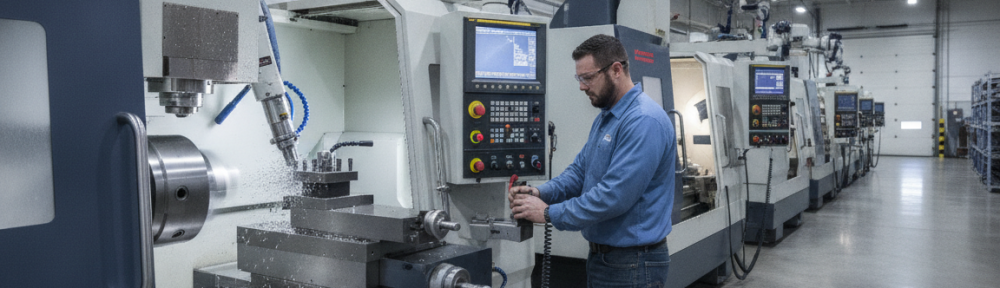
Procurement professionals and product engineers frequently turn to Houston’s extensive manufacturing industry when sourcing high-precision parts. Manufacturing represents close to 12% of Texas output, produces roughly $226 billion in economic activity, and employs nearly 900,000 people. Such a large manufacturing base allows Houston industrial machining services to expand their expertise, capacity, and range of available solutions.
CNC Machine Shop Houston
This review evaluates machining services throughout Houston, including independent local specialists, nationwide precision-machining companies with Houston operations, and regional contract manufacturers. Examples include Lowrance Machine, available at www.lowrancemachine.com, along with RBR Machine and regional contract firms such as Centerline. Together, these businesses demonstrate the broad diversity found across the Houston machine-shop ecosystem.
This guide is intended to help product developers, purchasing teams, and OEMs in oil and gas, aerospace, medical-device, industrial, and related markets identify the most appropriate machining company in Houston. Covered capabilities include CNC milling, advanced 5-axis work, high-accuracy machining, and end-to-end turnkey manufacturing. Later sections explain available technologies, production capabilities, and supplier-selection criteria so teams can compare providers by tolerance control, turnaround time, and additional value-added services.
Key Takeaways
- Houston’s large manufacturing economy makes the region a dependable source of precision-machining services.
- The featured suppliers include local specialists, including Lowrance Machine, together with nationwide manufacturers operating in Houston.
- Houston shops offer capabilities ranging from basic milling operations to complex multi-axis machining and end-to-end production.
- Target readers include sourcing managers, design engineers, manufacturing personnel, and original-equipment manufacturers.
- The following sections cover supplier evaluation, pricing considerations, turnaround schedules, and real-world machining applications.
Industrial Machining In Houston: Services, Growth, And Market Conditions
Houston’s manufacturing sector has expanded considerably as demand from the energy, aerospace, medical, and petrochemical industries continues to increase. Growing requirements for intricate, tightly toleranced parts have prompted Houston machining providers to increase both capacity and technical capability. The city’s access to highways, ports, and rail systems creates important logistical advantages by limiting transportation costs and delivery delays.
The availability of skilled engineers, programmers, and machinists throughout Texas supports sophisticated production using 3-, 4-, and 5-axis equipment. By reducing repositioning and setup requirements, these capabilities allow industrial machine shops in Texas to achieve faster and more efficient production. Access to experienced local workers supports faster implementation of modern processes and reduces delays associated with hiring specialised employees.
Modern machining technologies are routinely incorporated into the everyday operations of leading Houston shops. Five-axis CNC machines reduce fixture requirements and minimise changeovers when producing parts with intricate shapes. Shops employ wire EDM to produce intricate cuts, narrow openings, and accurate details in hardened or thin conductive parts. Large-format milling machines allow regional manufacturers to complete oversized, single-piece work that might otherwise be sent to facilities outside Texas.
Quality-assurance equipment is just as important as machining equipment when producing critical components. Many shops use Zeiss coordinate measuring machines for first-piece reports, production inspection, and ongoing dimensional confirmation. Such inspection tools confirm compliance with strict tolerances and provide measurements that can be repeated and verified.
Selecting a local Houston machine shop offers advantages such as simpler communication and faster face-to-face reviews during design, prototyping, and first-article approval. Nearby manufacturers can adjust more rapidly to revised quantities, updated drawings, and accelerated delivery needs. Compared with distant overseas sourcing, local production lowers logistical complexity and adds the commercial appeal of American-made parts backed by accessible supplier support.
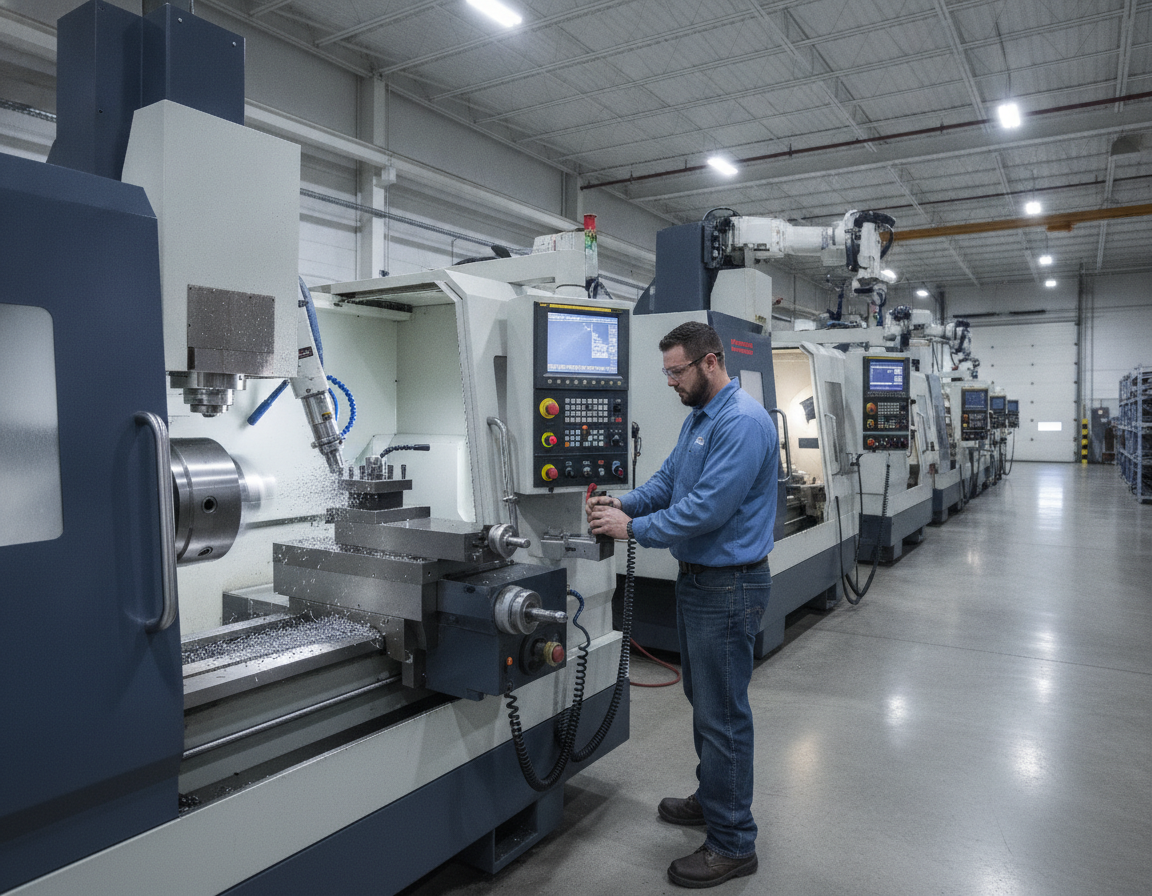 CNC Machine Shop Houston
Leading Houston Providers And Their Distinguishing Capabilities
Buyers in Houston can choose from a mixture of nearby machining firms and larger contract manufacturers with specialised technical capabilities. This supplier mix gives customers faster turnaround, direct collaboration, and simpler logistics than they may receive from distant manufacturers. The following businesses stand out for CNC machining and broader production support.
Lowrance Machine has built a Houston reputation around personal service and responsive project coordination. The business focuses on CNC milling, made-to-order machining, and fabrication while prioritising quick project completion. The nearby facility supports direct quality checks, convenient meetings, and flexible supply-chain management for clients seeking an agile Houston machine shop.
RBR Machine provides precision and 5-axis machining for customers requiring complex parts and extensive production capabilities. The company maintains ISO 9001:2015, ISO 13485, AS9100D, and ITAR credentials and offers turnkey support from initial prototypes through final assembly. The provider supports demanding sectors through quick quotations, detailed CMM measurement, API threading services, strong quality systems, and accelerated scheduling options.
Centerline, together with other area contract-production firms, accommodates projects ranging from small batches to substantial manufacturing runs. Centerline supplies certified domestic manufacturing under ISO 9001:2015 and AS9100D quality systems. These nearby manufacturers strengthen sourcing flexibility, shorten response times, and offer many buyers a reliable substitute for overseas suppliers.
Choosing between these companies requires consideration of design difficulty, compliance requirements, production volume, and turnaround needs. RBR Machine may be suited to programs needing multi-axis machining, oversized milling, or highly controlled quality systems. Lowrance Machine or a comparable local provider may be preferable when quick delivery, regular meetings, and accessible service are priorities.
| Provider | Core Strength | Quality Credentials | Most Suitable Projects |
|---|---|---|---|
| Lowrance Machine | Local CNC milling and metal fabrication with responsive support | Established manufacturing procedures and in-house quality checks | Short-run projects, urgent schedules, and direct customer involvement |
| RBR Machine | Five-axis machining, large-format milling, and turnkey production | Quality, medical, aerospace, and defence credentials including ISO and ITAR compliance | High-precision aerospace, defence, medical, and oil-and-gas components |
| Centerline Houston | Scalable contract-manufacturing support for varying order quantities | ISO 9001:2015 and AS9100D | Certified domestic production runs and scalable sourcing requirements |
The search for a Houston CNC partner should consider turnaround speed, quality systems, inspection technology, total price, and location. Regional providers combine trained machinists, customer support, and broad industrial-manufacturing services to serve varied applications within Houston and beyond.
What To Evaluate In A CNC Machining Provider
The process of identifying a suitable CNC shop should include a thorough examination of its manufacturing resources, quality procedures, and service range. Buyers should verify that the company maintains disciplined quality-control practices and modern equipment while offering services that simplify the wider supply chain. Shops offering precision machining together with fabrication and downstream operations reduce handoffs by delivering parts prepared for the next production stage.
Precision machining services depend on reliable control of dimensional tolerances. Many projects specify tolerances between roughly ±0.001 and ±0.005 inches, although the exact requirement varies by shape and material. Aerospace, healthcare, and defence manufacturers often rely on CMM reports, first-article inspection, optical systems, nondestructive examination, and hardness tests. Recognised quality certifications confirm the use of documented systems that simplify customer audits and formal acceptance processes.
Third-party coordinate-measuring services can independently verify critical dimensions without requiring the customer to change machining providers. This approach strengthens quality assurance while preserving the existing supplier relationship.
Advanced machining technologies enable shops to produce intricate shapes while reducing cycle time and unnecessary setups. Five-axis machining in Houston reduces repositioning and setup counts while creating contoured parts used in aerospace, medical, and other precision applications. Houston wire electrical-discharge machining is ideal for precise openings, thin sections, tight internal radii, and fragile conductive parts. Large-format milling handles oversized energy and heavy-equipment components using machine beds that may exceed 100 inches in length and width.
Complementary processes increase the range of components a machining company can complete internally. Small precision parts suit Swiss-style turning, whereas robust CNC turning centres handle greater diameters and extended lengths. Houston shops offering milling, turning, and wire EDM together can manage diverse component families without extensive outsourcing.
End-to-end manufacturing simplifies purchasing, lowers administrative effort, and helps accelerate delivery. True turnkey manufacturing covers design assistance, sample creation, full production, outsourced treatments, final assembly, finishing, and delivery management. Many local contract firms combine surface coating, anodising, thermal processing, kit preparation, and sourcing administration under a single order.
Additional services have greater value when a project must move quickly. Expedited scheduling, internal finishing, and in-house assembly reduce supplier handoffs and shorten time-to-market. Combining these services with one partner limits handovers and establishes a single point of accountability for completed components.
Selecting And Assessing A Houston Machining Provider
The first step is to create a complete technical and commercial specification for the work. Clarify the production stage, expected batch size, annual demand, and metals or plastics to be machined. The request should also address tolerances, cosmetic or functional finishes, inspection needs, and relevant compliance standards. Detailed specifications speed up estimates from Houston CNC shops and minimise misunderstandings that could lead to costly revisions.
Prior to commitment, verify that the machining company maintains all quality credentials and documented systems needed for the work. Ask whether the business holds ISO 9001:2015, AS9100D, or ISO 13485 certification and whether ITAR registration is maintained for defence programs. Such credentials indicate that controlled processes, recordkeeping, traceability, and inspection systems are formally maintained.
A supplier’s machinery and expertise must align closely with the geometry, material, and tolerances of the part. Verify the availability of advanced 5-axis equipment, wire electrical-discharge machining, Swiss-style lathes, and oversized milling systems. Also review CMM inspection capacity and secondary services such as heat treatment, plating, coating, fabrication, or assembly. Reliable Houston machining companies normally publish or provide machine lists, capacity details, and examples of similar completed work.
Assess how promptly and accurately each company responds to requests for pricing and scheduling. Vendors capable of supplying prompt, transparent quotations and genuine rush options may reduce project risk. Accurate estimates and dependable delivery information allow teams to plan more effectively and mitigate schedule risk.
The supplier should provide a clear description of its quality-verification and recordkeeping process. Request CMM reports, First Article Inspection procedures, raw-material certificates, and dimensional-inspection records. A reputable industrial machine shop Texas provider should supply documentation that supports audits, approvals, and regulatory compliance.
The ability to communicate quickly and obtain nearby technical assistance can materially affect project success. In-person engineering meetings and convenient shop access make it easier to solve technical issues while limiting transport expense. A regional supplier often offers better supply-chain adaptability and quicker support for unexpected requirements.
Compare the complete landed cost of Houston machining with the true expense of purchasing from offshore suppliers. Account for freight, tariffs, customs processing, inventory carrying costs, schedule risk, quality problems, and engineering-change expenses. Once hidden costs and market-launch timing are considered, custom machining from nearby shops may prove more economical than overseas alternatives.
Review customer examples, documented projects, and previous experience in markets similar to your own. Seek manufacturers with demonstrated success in energy, aviation, healthcare, vehicle production, power, or comparable markets. The strongest evidence includes relevant finished parts, quality outcomes, and consistent schedule performance.
Determine whether the supplier can support the project after initial delivery and expand production when demand grows. Evaluate whether the shop can support prototypes, pilot runs, regular production, final assembly, and longer-term sourcing agreements. A scalable precision-machining service reduces the need to transfer mature products to a different manufacturer later.
Supplier comparisons become more consistent when teams score technical specifications, quality credentials, machinery, quoting, documentation, support, cost, history, and production scalability. Applying consistent criteria allows decision-makers to choose a Houston shop aligned with performance, schedule, quality, and financial requirements.
Pricing, Turnaround, And Common Uses Of Industrial Machining In Houston
Several variables influence Houston machining rates, including geometry, raw material, setup requirements, and batch quantity. Demanding dimensional requirements and additional operations, including heat treat and plating, generally increase project pricing. Hard-to-machine materials and complicated features increase programming effort, tool wear, and production time. Five-axis production carries greater upfront programming expense but may reduce overall cost through fewer operations and less repositioning.
Budgeting should consider the quoted unit price together with all indirect and supporting expenses. Shipping, purchasing administration, storage, customs duties, rejected components, and late delivery can all affect the final cost. Domestic sourcing frequently limits transportation, inventory, and coordination expenses associated with distant suppliers.
Delivery schedules are affected by the selected provider, current production commitments, design requirements, and supporting operations. Fast-estimating shops with genuine rush capacity can reduce prototype delays and bring production launches forward. Nearby machining reduces transportation complexity and allows projects to progress without the extended shipping associated with overseas suppliers. Geographic proximity also supports faster engineering revisions, emergency replacements, and urgent repeat orders.
Work subject to strict industry requirements should be placed with shops maintaining formal quality credentials and coordinate-measurement resources. Strong compliance and measurement systems minimise rejected components, corrective work, approval problems, and production delays.
Practical industrial applications demonstrate the range and value of Houston machining capabilities. Oilfield projects commonly demand substantial machining envelopes, strong alloys, and parts capable of enduring high pressure and harsh environments. Aerospace and defence projects frequently require five-axis machining, AS9100D quality controls, detailed documentation, and precise inspection. Medical-device manufacturing relies on wire EDM, Swiss turning, ISO 13485 procedures, and complete material traceability. Power and renewable-energy equipment frequently calls for oversized machining, strong components, and heavy-duty finishing processes.
Machining companies capable of both fast development work and complete manufacturing simplify the path from idea to finished product. They can transfer designs from proof-of-concept through pilot production and full manufacturing while minimising supplier handoffs.
For time-sensitive or compliance-intensive projects, prioritise local providers that demonstrate rigorous process control and dependable coordinate measurement. Choose providers with documented multi-axis experience when designs involve compound angles, deep features, or complex surfaces. For recurring orders and unpredictable volume, flexible contract manufacturers may provide more dependable long-range sourcing. Combining accessible local companies such as Lowrance Machine with specialised regional providers can balance cost, delivery speed, production capacity, and technical expertise.
Related: Understanding the Capabilities of 5-Axis Machining in Houston