This overview highlights the significance of Type L copper wall thickness in plumbing systems nationwide. Experts like contractors, engineers, and procurement managers rely on exact copper pipe specifications. This data is crucial for sizing pipes, pressure calculations, and ensuring durable installations. Our guide employs core data from ASTM B88 and Taylor Walraven to aid in picking the appropriate plumbing materials and fittings.
Best Prices On 5 In Copper Pipe
Type L copper tubing offers a balance between durability and price, rendering it perfect for diverse water distribution and mechanical systems. Comprehending the nuances of metal wall thickness, nominal and actual dimensions, and how they affect ID is critical. This understanding enables crews to select the most suitable copper piping for home and business projects alike. The text also cites relevant standards, including ASTM B88 and EN 1057, as well as related ASTM specifications such as B280 and B302 specs.
Key Takeaways
- Type L copper wall thickness is a popular selection for piping because of its mix of durability and affordability.
- Key sources like ASTM B88 and Taylor Walraven supply the size and weight info needed for precise sizing.
- Metal wall thickness directly affects inside diameter, pressure rating, and flow performance.
- Procurement must consider market conditions, material temper, and supplier options such as Installation Parts Supply distributors.
- Understanding standards (ASTM B88, EN 1057) and associated specifications (B280, B302) guarantees installations that meet code.
Overview Of Copper Piping Types And Where Type L Fits
Copper piping is classified into various grades, every one having its own wall gauge, cost, and application. Professionals depend on astm standards and EN standards when selecting materials for jobs.
K L M DWV comparison illustrates Type L’s position. Type K, with its thick walls, is ideal for underground use and high-stress areas. Type L copper, with a medium wall, is the standard choice for indoor water lines. Type M copper is lighter, suitable for cost-conscious projects with lower stress requirements. DWV is for gravity systems and must not handle drinking water.
This part describes the typical applications and reasoning behind choosing Type L pipe. For most jobs, Type L’s wall thickness provides a compromise of pressure ratings and thermal durability. It’s suitable for branches, hot-water systems, and HVAC because of its toughness and manageable weight. Type L is compatible with various fittings and is available in hard and soft tempers.
Standards dictate the sizes and allowances of copper tubes. ASTM B88 is vital for US sizes, outlining K, L, and M types. Standard EN 1057 is the European standard for plumbing and heating. Other ASTM specifications cover related uses in plumbing.
A quick reference table is included for easy checking. For exact specs, consult the B88 standard and manufacturer data such as Taylor Walraven.
| Type | Wall Characteristic | Typical Applications | Pressure Use |
|---|---|---|---|
| Grade K | Heavy wall; max protection | Underground service, domestic water service, fire protection, solar, HVAC | Yes |
| Grade L | Medium wall; balanced strength and cost | Interior water distribution, branch runs, hot water, many commercial systems | Allowed |
| Grade M | Thin wall; cost-efficient | Residential indoor, light commercial | Yes, lower pressure margin |
| Drain Waste Vent | Thin drainage wall | Drain, waste, vent; not for potable pressurized water | No |
Local codes and job specs must match with astm standards and EN standards. Ensure compatibility with fittings and joining methods before finalizing your piping selection.
Type L Copper Wall Thickness
The thickness of Type L walls is key to a pipe’s strength, pressure rating, and flow rate. This section outlines B88 standard values, lists common sizes with their gauges, and clarifies how outside diameter (OD) and inside diameter (ID) affect pipe sizing.
ASTM B88 nominal charts detail standard ODs and thicknesses for Type L pipe. These numbers are essential for designers and installers when selecting pipes and connectors from makers such as Taylor Walraven and Mueller.
Summary Table Of ASTM B88 Nominal Wall Thickness For Type L
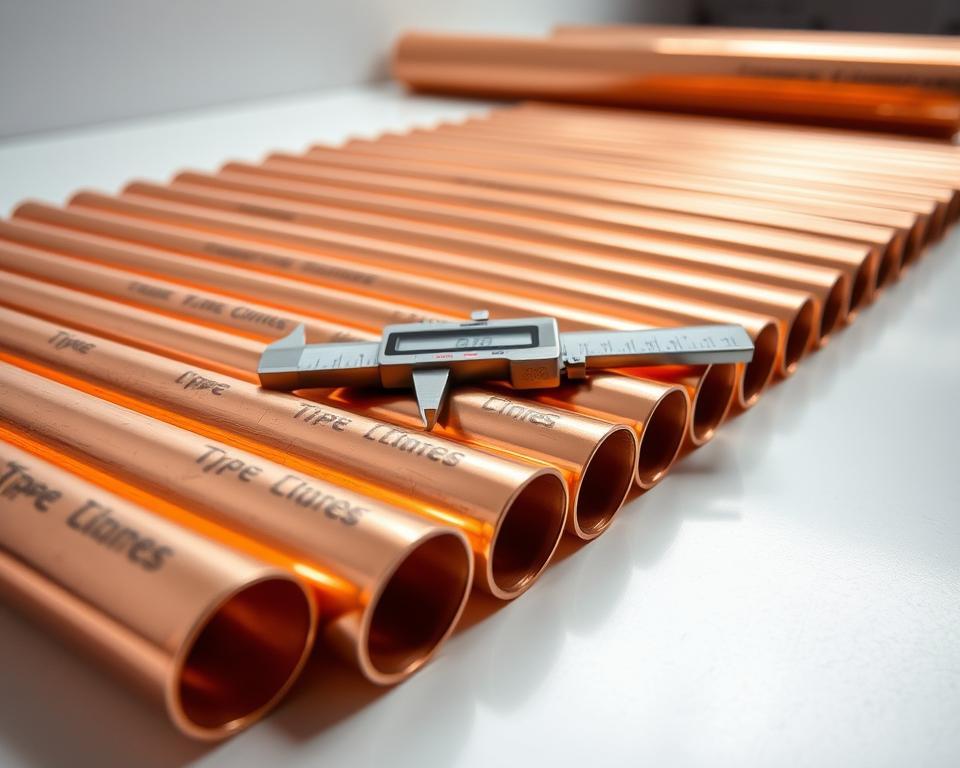
The table below displays common nominal dimensions, their Type L wall thickness, and linear weight. These values are standard for pressure ratings and quantity estimates.
| Size (Nom) | Outside Diameter (OD) | Thickness | Weight (lb/ft) |
|---|---|---|---|
| 1/4″ | 0.375″ | 0.030″ | 0.126 |
| 3/8″ | 0.500″ | 0.035″ | 0.198 |
| 1/2″ | 0.625″ | 0.040″ | 0.285 |
| 5/8″ | 0.750″ | 0.042″ | 0.362 |
| 3/4″ | 0.875″ | 0.045″ | 0.455 |
| 1″ | 1.125″ | 0.050″ | 0.655 |
| 1-1/4″ | 1.375″ | 0.055″ | 0.884 |
| 1-1/2″ | 1.625″ | 0.060″ | 1.14 |
| 2″ | 2.125″ | 0.070″ | 1.75 |
| 2-1/2″ | 2.625″ | 0.080″ | 2.48 |
| 3″ | 3.125″ | 0.090″ | 3.33 |
| 3-1/2″ | 3.625″ | 0.100″ | 4.29 |
| 4″ | 4.125″ | 0.110″ | 5.38 |
| 5″ | 5.125″ | 0.125″ | 7.61 |
| 6″ | 6.125″ | 0.140″ | 10.20 |
| 8″ | 8.125″ | 0.200″ | 19.28 |
| 10″ | 10.125″ | 0.250″ | 31.10 |
| 12″ | 12.125″ | 0.280″ | 40.40 |
Common Nominal Sizes And Corresponding Wall Thickness
Fast reference numbers are essential on construction sites. For instance, a 1/2″ nominal has a Type L thickness of 0.040″. A 1-inch pipe has a 0.050-inch wall. Larger sizes feature 3-inch at 0.090 and 8″ at 0.200″. These figures help estimate piping costs when comparing 1/2 inch copper prices or bigger sizes.
OD, ID And How Wall Thickness Affects Usable Internal Diameter
Nominal dimension is a designation, not the actual outside diameter. ASTM B88 nominal tables list OD values. For many sizes, the OD is about 1/8″ larger than the nominal label.
Inside diameter is OD minus two times the metal wall thickness. Thicker walls reduces internal diameter and flow capacity. This difference impacts friction loss, pump sizing, and fittings compatibility.
Practitioners perform sizing math using OD and wall specs from ASTM charts or manufacturer tables. Accurate ID values ensure proper choice of test plugs, testing equipment, and hydraulic equipment for a specific project.
Key Dimensions For Type L Copper Tubing
This section points out important figures for Type L copper tubing to assist in dimensioning, fitting selection, and material takeoff. The table below shows selected nominal sizes with outside diameter, type l copper wall thickness, and weight per foot. Reference these figures to verify fit with connections and to estimate transport needs for big pipe installations.
Review the rows by size name, then verify the OD and thickness to compute ID. Note the increased mass for larger diameters, which impact shipping and installation planning for items such as an 8 copper pipe.
| Size | Outside Diameter (OD) | Wall Thick. | Inside Diameter (ID) | Wt/Ft |
|---|---|---|---|---|
| 1/4″ | 0.375″ | 0.030″ | 0.315″ | 0.126 lb/ft |
| 3/8″ | 0.500″ | 0.035″ | 0.430″ | 0.198 lb/ft |
| 1/2″ | 0.625″ | 0.040″ | 0.545″ | 0.285 lb/ft |
| 3/4″ | 0.875″ | 0.045″ | 0.785″ | 0.455 lb/ft |
| 1″ | 1.125″ | 0.050″ | 1.025″ | 0.655 lb/ft |
| 2″ | 2.125″ | 0.070″ | 1.985″ | 1.75 lb/ft |
| 3″ | 3.125″ | 0.090″ | 2.945″ | 3.33 lb/ft |
| 6″ | 6.125″ | 0.140″ | 5.845″ | 10.20 lb/ft |
| 8″ | 8.125″ | 0.200″ | 7.725″ | 19.28 lb/ft |
| 10″ | 10.125″ | 0.250″ | 9.625″ | 31.10 lb/ft |
| 12″ | 12.125″ | 0.280″ | 11.565″ | 40.40 lb/ft |
Big copper pipes such as 6 through 12 inches show significantly greater weight. Plan for heavy lifting, larger supports, and specialized joining methods when designing these lines. Installers who offer copper pipe field services must account for hoisting and moving at the jobsite.
How to read tube charts: start with the nominal dimension, check the listed OD, then note the type l copper wall thickness to compute the ID by subtracting twice the wall from the OD. Use the weight per foot column for estimates and structural load checks. For plug selection and hydro testing, confirm ID and wall with plug spec sheets and pressure tables.
Considerations For Performance: Flow, Temperature, And Pressure
Comprehending copper tubing performance involves weighing durability, temperature limits, and hydraulic flow. In the piping trade, engineers use working pressure charts and flow charts to select the right tube type. They must consider physical stresses and flow goals for each run when choosing Type L.
Pressure Rating Variances Between Types K, L And M
Standard ASTM charts show pressure ratings for different sizes and gauges. Grade K has the max pressure rating, then Type L, and then Type M. It’s essential for engineers to check the exact working pressure for the selected size and temper prior to design sign-off.
Effect Of Wall Thickness On Maximum Allowable Pressure And Safety Factor
Type l copper wall thickness directly impacts the maximum allowable internal pressure. Thicker walls boost burst pressure and stress limits, giving a larger safety factor against mechanical damage or thermal cycling. Wall thickness also influences the bend radius and may influence the choice between drawn or annealed tube for certain joining methods.
Water Velocity, Flow Capacity, And Pressure Loss Relative To Size
Increasing wall thickness shrinks the ID, reducing the capacity. This decrease leads to faster speeds at the same flow rate, raising pressure drop. When sizing pipes, figure the ID from the OD less 2x wall to accurately determine flow characteristics and drag.
| Size | Wall (K/L/M) | Approx. ID (in) | Relative Working Pressure | Loss Factor |
|---|---|---|---|---|
| 1/2″ | 0.049 / 0.040 / 0.028 | 0.546 / 0.628 / 0.740 | K > L > M | Smaller ID = more friction |
| 1″ | 0.065 / 0.050 / 0.035 | 1.030 / 1.135 / 1.250 | K > L > M | Type l copper wall thickness reduces flow area, increases loss |
| 3″ | 0.120 / 0.090 / 0.065 | 2.760 / 2.900 / 3.030 | K > L > M | Drop varies more at high flow |
Consult flow charts for copper or calculate hydraulics for every loop. Designers need to check speed caps to prevent erosion-corrosion and noise. Heat derating is required where joints or soldered assemblies may lose pressure capacity at higher operating temperatures.
Practical pipe sizing merges allowable working pressure, type l copper wall thickness, and expected flow. The industry norm is to consult ASTM tables and code restrictions, then confirm pump specs and losses to reach a safe, quiet system.
Requirements For Specifications And ASTM Standards In Copper Tubing
Understanding the governing standards for copper pipes is essential for following specs. Blueprints and POs often reference ASTM standards and EN 1057. These documents define sizes, limits, and hardness. Specifiers rely on them to ensure the materials and methods match the intended application.
Standard B88 serves as the foundation for potable water tubes in the United States. It specifies sizes, outside diameters, thicknesses, tolerances, and weights for Types K, L, and M. The standard also specifies soft and hard tempers and compatibility with different connectors.
ASTM B280 controls refrigeration tubing for cooling systems, with specific pressure limits and dimensional controls compared to B88. B302 and B306 cover drainage and threadless copper for mechanical and drainage systems. Standard EN 1057 offers metric equivalents, serving EU jobs and those requiring metric tolerances.
Material temper greatly affects installation. Soft copper is more pliable, allowing easy bending in the field. It works well for flared and many compression fittings once prepped. Conversely, drawn tube is harder, resisting denting, and performs well with sweat fittings and in long runs.
Size tolerance is a critical factor. ASTM charts list OD limits ranging from ±0.002″ to ±0.005″ by size. A precise outside diameter is essential for good joints. Specifying the tolerance band in purchasing can avoid installation problems.
Suppliers such as Taylor Walraven and Petersen offer I.D., OD, and wall charts. These tools aid in selecting plugs and calculating load. Using these charts alongside ASTM B88 or EN 1057 ensures compatibility between material and fittings. This method reduces errors during copper pipe field services and streamlines procurement.
| Standard | Primary Scope | Type L Relevance |
|---|---|---|
| B88 | Seamless copper water tube; sizes, wall thickness, tolerances, weights | Defines Type L dimensions, tempers, and joining suitability |
| ASTM B280 | Copper tube for ACR; pressure ratings and dimensions | Used when copper serves HVAC refrigeration systems |
| B302/B306 | DWV and threadless specs | For drainage/special use |
| EN 1057 | Metric water/gas tube specs | Metric specs for global jobs |
Job specs must state the required ASTM standards, acceptable tempers, and OD tolerance class. This info prevents mismatches at installation and guarantees operation under load and during commissioning tests.
Unique uses may necessitate additional controls. Medical gas, oxygen services, and certain industrial uses need specific standards and restrictions. Local codes might ban copper for gas lines in some U.S. jurisdictions due to embrittlement risks. Always verify authorities having jurisdiction before deciding.
Sourcing And Costs: Price Examples And Wholesale Availability
Costs for Type L copper tubing fluctuates depending on the copper market, fabrication needs, and supply-chain factors. Buyers need to watch copper indexes when planning budgets. For short runs, retailers quote by the foot. For bulk jobs, distributors offer reels or straight lengths with volume discounts.
Before finalizing procurement, check current quotes for copper pipe 1/2 inch price and 3 inch copper pipe price. Small 1/2″ L pipe is usually found as coil or stick and is priced per foot or per coil. Three-inch Type L carries a higher price per foot because of material weight and bending or forming steps.
Price factors to watch
Commodity copper swings, mill lead times, and temper choice (soft vs hard) are main cost factors. Hard copper can cost more than soft copper. Coils vs sticks affect handling and shipping charges. Ask for B88 certs and temper details on every bid.
Costs for big pipes
Large copper tube sizes increase material, shipping, and installation expense rapidly. An 8 copper pipe weighs far more per foot than smaller tubes. That extra weight boosts shipping fees and requires heavier supports on site. Fabrication for large runs, special fittings, and heat treating increase the final installed price.
| Dimension | Pricing Method | Key Cost Drivers |
|---|---|---|
| 1/2″ Type L | By foot/coil | Coil handling, small-diameter production, market copper price |
| 3″ Type L | Per linear foot | Weight, fab, fittings |
| 6-10 in Pipe | Foot + Freight | Weight, shipping, supports, annealing |
Wholesale sourcing and distributor note
For volume purchases, use well-known wholesale distributor channels. Installation Parts Supply carries Type L and other copper tubing and offers lead-time estimates, volume pricing, and compliance documents. Buyers must check OD and wall specs and check format—roll or stick—to fit the job needs.
When bidding, request detailed quotes that breaks out material, fab, and shipping. This detail aids comparison for the same quality of copper tubing and avoids surprises later on.
Methods Of Installation, Joining, And Field Services
Type L tubing demands precise handling during setup. The proper prep, flux, and solder are critical for lasting joints. Drawn temper is ideal for soldering, whereas soft tube is better for bending and flare fittings.
Sweat solder, compression, and flare fittings each have unique uses. Sweating creates permanent joints for potable water, adhering to codes. Compression are great for quick assemblies in tight spaces and for repairs. Flare joints are ideal for soft, annealed tube and gas or refrigeration lines, ensuring sealed joints.
Field services teams must follow a detailed checklist for pressure testing and handling. Plugs must match the tube’s OD/ID and respect wall thickness. Always consult maker data for test limits. Log results and check connections for solder coverage and proper seating of compression ferrules.
Hanger spacing is key for durability. Use support spacing guidelines based on tube size and orientation to prevent sagging. Larger diameters and heavy runs require closer hangers. Anchor points and expansion allowances prevent stress on fittings.
Expansion needs planning on long runs and HVAC circuits. Install loops, guides, or slides for temperature changes. Copper’s expansion rate is significant in hot water/solar jobs.
Common mistakes include misreading dimensions and temper. Mixing up nominal vs OD results in mismatched parts. Specifying Type M in high-pressure applications can lower safety. Verify OD tolerances and temper with standards before building.
Plumbing codes set use limits and material specs. Review local rules for potable water, medical gas, and fire protection work. Some jurisdictions limit copper for gas; adhere to ASTM on odorant and moisture-related cracking risks.
Moving big pipes requires mechanical gear and care during moving. Heavy pipes such as 8-10 inch need rigging plans, slings, and support to avoid dents or bends that ruin fittings.
Use standard logs and training for field crews. This cuts mistakes, boosts pass rates, and keeps jobs on time in building construction.
Final Thoughts
Type L Copper Wall Thickness offers a compromise for diverse piping jobs. It features a standard wall, better than Type M in pressure rating. However, it costs less and lighter than Type K. This renders it a flexible option for potable water, heating, and HVAC applications.
Always consult B88 standards and vendor tables, such as Taylor Walraven, for specs. These documents list OD, nominal wall thickness, ID, and weight per foot. Ensuring these specifications are met is key for correct hydraulic calculations and fitting compatibility. Including sweat, compression, and flare joining methods.
When planning your budget, keep an eye on material costs. Look at wholesale distributors such as Installation Parts Supply for availability and compliance certificates. Remember to consider working pressures, temperature impacts, support spacing, and local codes. This assists in achieve installations that are both durable and compliant with regulations.